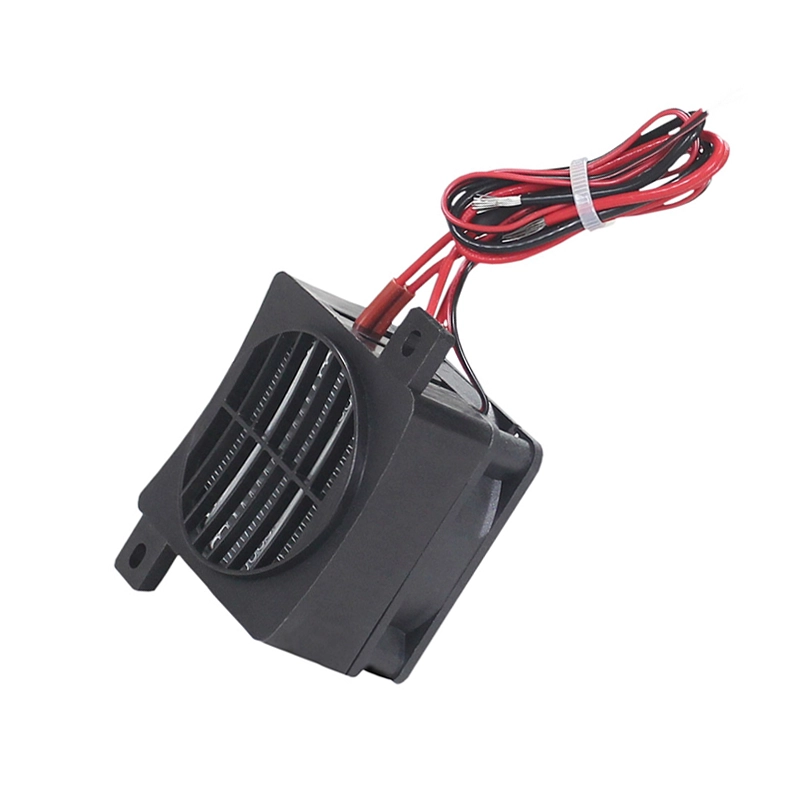
Keeping a Ptc Fan Heater comparison evidence-based while reviewing assumptions for early research
A ptc fan heater comparison can look simple until an application must fit a real enclosure, power system, and control plan. For early research, application engineers should separate three things: what the page states, what the proposed use requires, and what still needs technical confirmation. This approach keeps a promising candidate from becoming an untested design assumption.

Set the criteria before comparing candidates
Begin with the operating context. Define the equipment, the space available for the heater, the intended airflow path, and the temperature-control method. The captured product page lists a fan-integrated module with a compact housing, front grill outlet, and side mounting bracket. It also lists a 50–200W range and 12–220V wide-voltage range for that product. These details can form an initial comparison record, but they should remain tied to the named module rather than generalized to every heater in the category.
Next, write the electrical and mechanical requirements in separate fields. A voltage range may help screen candidates, while wattage helps identify whether a product belongs in the discussion. Neither detail alone proves that the heater will meet the thermal needs of a particular chamber or cabinet. The early comparison should therefore record the specification and the design question beside it: does the intended system provide a matching supply, mounting arrangement, airflow route, and control method?
Review evidence by requirement
Supplier research becomes more useful when each claim is matched to one requirement. The product page describes compatibility with mechanical thermostats, electronic thermostats, thermal switches, and PLC systems. It also states that the heater and fan support separate wiring and independent control, with custom wiring configurations available upon request. These statements support a discussion about control integration. They do not, by themselves, establish a complete control design, a response profile, or suitability for a specific process.
When reviewing ptc fan heater suppliers, treat the product page as one source in an evidence map. Record the exact product scope, the stated application, and the question that remains open. The page identifies applications including egg incubators, 3D printers, HVAC, medical and laboratory equipment, industrial machinery, and electrical cabinets. That list can help an engineer decide whether the use case is within the page’s stated context. It should not be read as proof that every listed application has the same requirements or outcome.
- Tie the 50–200W and 12–220V values to the specific insulated module rather than the whole product category.
- Record thermostat, thermal-switch, and PLC compatibility as control-integration evidence, not as a complete system design.
- Consider separate heater and fan wiring when defining the required control and connection arrangement.
- Use the listed equipment contexts, including industrial machinery and electrical cabinets, to frame questions without claiming performance.
A useful real-world anchor is the page’s own analytical-cookie notice. It describes cookies used to understand visitor interactions through measures such as bounce rate and traffic source. That information concerns website activity, not heater performance. Its value in supplier research is different: it shows why an engineer should distinguish page content about the product from surrounding website content before adding a statement to a comparison record.
Keep trade-offs visible
A comparison becomes misleading when it presents only attractive specifications. Keep benefits, limits, and assumptions in adjacent columns. For example, the listed wide-voltage range may simplify an initial power-system screen, while the actual installation still depends on the equipment’s electrical architecture. Separate wiring may support a flexible integration discussion, while the final design still needs defined connections and control responsibilities.
Application images and labels can also guide the conversation without proving performance. The captured page shows an industrial drying cabinet and an enclosed FDM 3D printer among its application material. Those examples help an engineer ask whether the intended enclosure and airflow arrangement are comparable. They do not establish heating time, temperature uniformity, duty cycle, or long-term behavior. Keep those topics marked as design questions rather than filling them with estimates.
Create a repeatable decision record
Use the same review sequence for every candidate. First, copy only the page-listed product facts into the record. Second, map each fact to a requirement such as power, voltage, mounting, airflow, or control. Third, label each conclusion as stated, inferred for screening, or unresolved. Fourth, preserve the source location and product name beside the entry. This makes later supplier discussions focused and reduces the risk of carrying a category-level assumption into a model-level decision.
The record should also capture the intended next action. If the candidate appears relevant because of its listed applications, ask the engineering team to define the matching use conditions. If separate heater and fan wiring is important, make the required wiring arrangement part of the technical discussion. If the listed 50–200W and 12–220V values are used for screening, keep those numbers attached to the specific insulated module described on the page.
In summary, a defensible comparison is not a ranking based on the longest specification list. It is a controlled link between intended use, page-level evidence, and open engineering questions. PTCYIDU can be included as the named source for the captured module, while the final selection remains tied to the documented requirements and the evidence that applies to that product.