Where Sunjoy Hardtop Gazebos fits: think through clearance around doors and walkways for outdoor dining
Comparing SUNJOY hardtop gazebos starts with the space around your dining area, not with a roof label alone. A useful listing should help you match the shelter to your doors, walking routes, furniture plan, and the way you expect to use the backyard. Product-page details matter, but they work best after you understand the space they need to serve.

Start with the movement around the dining area
Look first at the route between the house, the dining table, the grill, and any storage area. Note where a door opens, where people naturally walk, and where chairs may move when guests sit down. The goal is not simply to fit a shelter into an empty rectangle. It is to preserve a practical path through the space.
Sketch the intended arrangement before comparing listings. Mark the dining table, chairs, serving area, and the edges of nearby doors or steps. Then compare that sketch with the dimensions and layout information shown for each model. A listing can look suitable at a glance while still requiring a more careful review of how furniture and circulation will work together.
Clearance also affects how the area feels during everyday use. A narrow route may become awkward when someone carries food, pulls out a chair, or passes behind a seated guest. These are planning questions rather than claims about any particular product. They help you decide which listed dimensions deserve the closest attention.
Read the listing as a set of specific choices
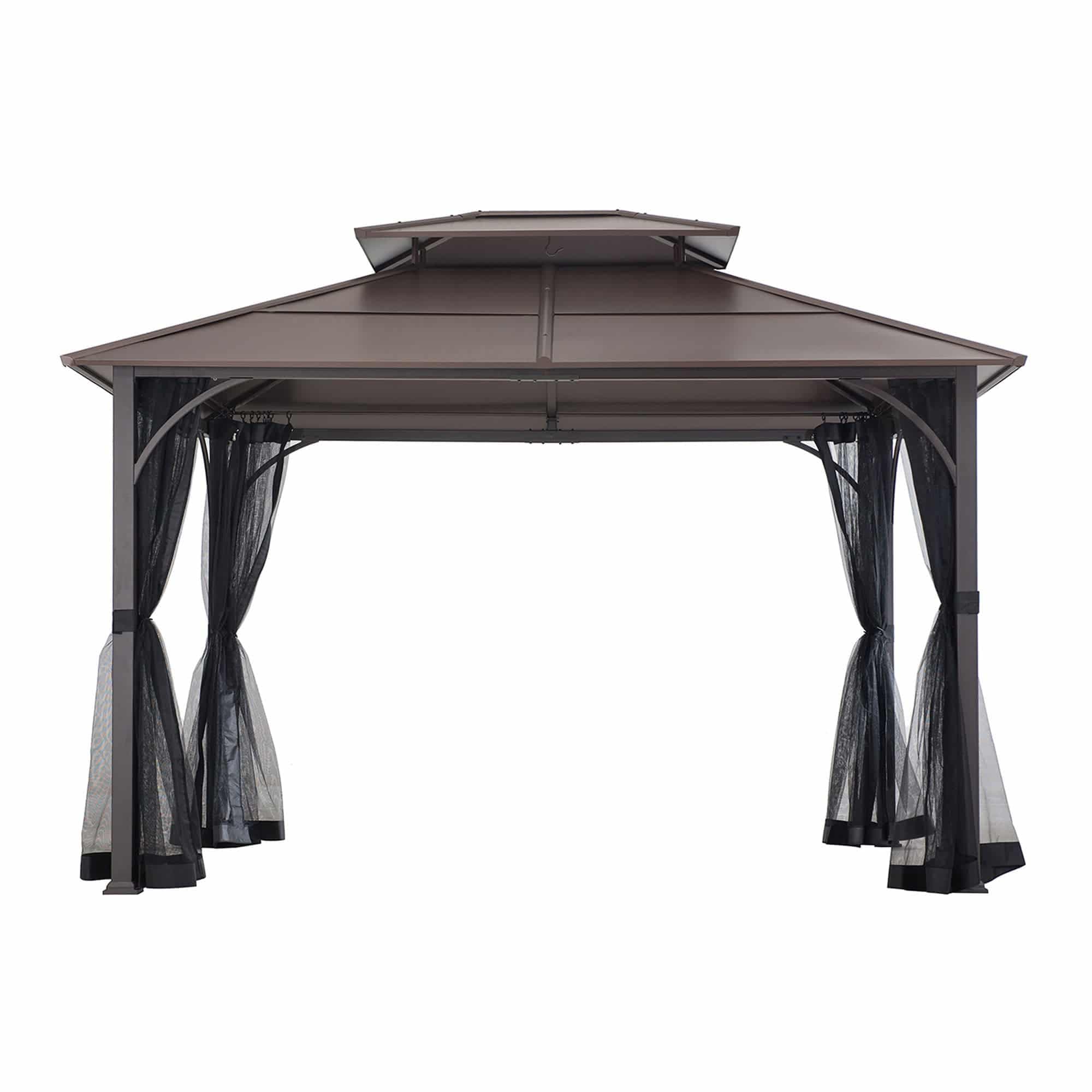
The SUNJOY hardtop collection labels roof styles including two-tier, gable, hip, octagon, and shed. It also lists materials such as steel, aluminum, polycarbonate, and wood. Treat these as collection-level labels, then look at the selected product page for the details that apply to that model. A category filter is useful for narrowing options, but it is not a substitute for model-specific information.
For shoppers comparing hardtop gazebos, the page also presents a hard-top versus soft-top comparison covering roof materials, weather-related claims, maintenance expectations, and use contexts. Use that comparison to frame questions about your intended setting. Do not turn a broad category description into a promise about every model. Keep the roof type, material, and any stated use context tied to the listing where you found them.
Accessories can influence the way you plan the space. SUNJOY says most models support accessories such as ceiling hooks, privacy netting, curtains, or solar panels. That wording matters: most does not mean all. If an accessory affects the position of a dining table, the openness of a walkway, or the way people enter the shelter, treat compatibility as a model-specific point to confirm from the selected listing.
- Record the roof style and material labels shown for the selected model, rather than relying only on collection filters.
- Use the hard-top versus soft-top comparison to frame questions about roof materials, weather-related claims, maintenance expectations, and use contexts.
- Treat accessory support as model-specific because SUNJOY says most models, not all, support listed accessories.
Turn the comparison into a short checklist
Once you have several candidates, review them in the same order. Begin with the footprint and the approach to the space. Next, record the roof style and material labels shown for each model. Then separate direct listing details from general expectations about how the area may function. Finally, note any accessory information that could change the layout or the way the shelter is used.
Keep a simple comparison note for each product. Write down what the page states, what your space requires, and what remains an assumption. This prevents an attractive image or broad category label from carrying more weight than the practical route around the dining area. It also makes it easier to remove a candidate that does not suit the planned arrangement.
If two listings appear similar, focus on the detail that changes your decision. That may be the roof style, the listed material, the stated use context, or accessory support. The strongest choice is not automatically the most elaborate option. It is the one whose documented details fit the space and whose layout leaves the doors and walkways workable for the people who will use them.
In the end, choose by connecting the product page to the real pattern of movement in your yard. Start with clearance, then compare the listed roof and material options, and treat accessory support as model-specific. A measured, use-led review gives SUNJOY a clear place in the decision without asking the brand or the listing to answer questions the evidence does not cover.